Hard Truths
About light and dark.

Author’s Note: This is my first post in a really long time and it’s much more philosophical than that which I usually share, but it’s what came to me today.
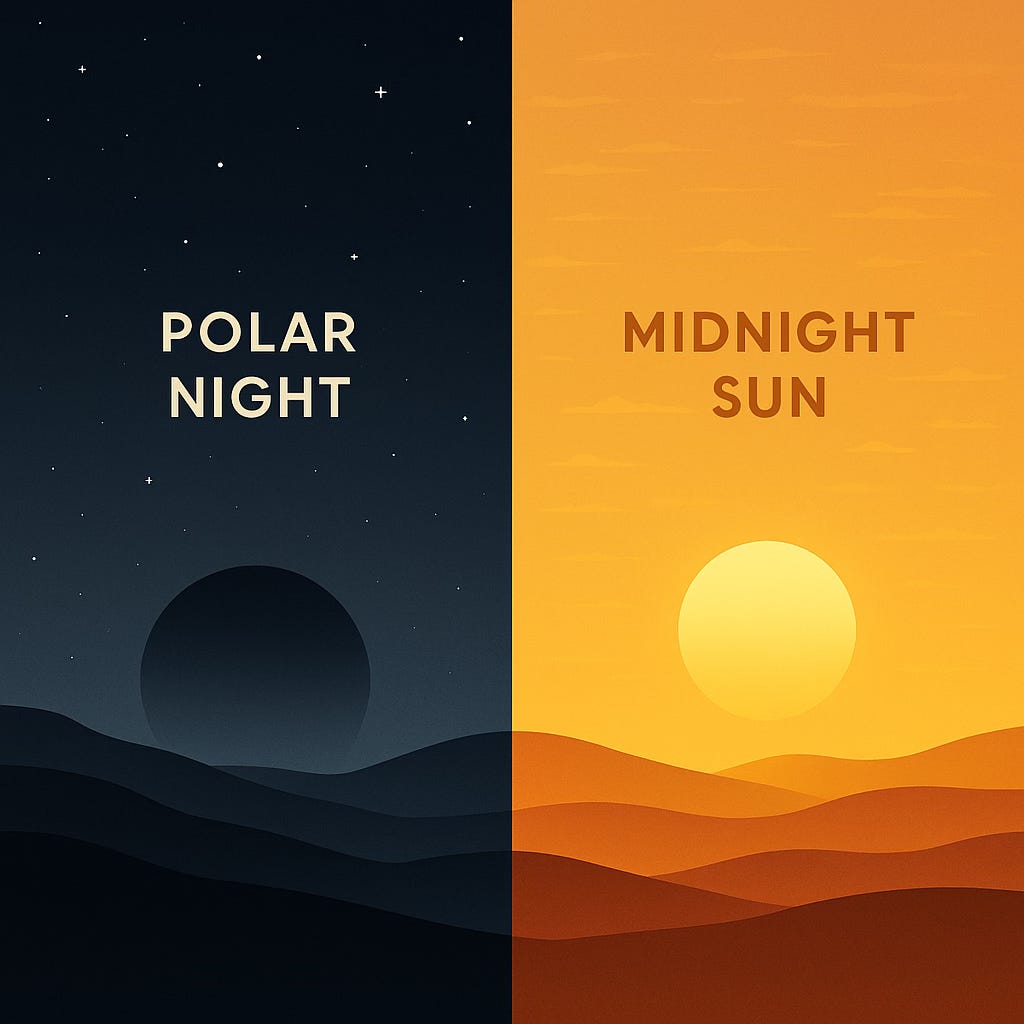
I’ve heard it said that, with enough time, darkness always gives way to light. I’m no longer sure if that’s true. In this moment, it feels the opposite of true. But, I suppose if it is true, then it is also true that light must also always eventually give way to darkness. And maybe that is the way of the world, the way of life, the way it is supposed to be. But, I have been surrounded by darkness for what seems like a small eternity now. And the childish, angry, self-pitying part of me is screaming that it’s not fair. But another part of me knows that fairness isn’t real. Light and dark don’t co-exist in equal measures at all times. But there is still balance.
The North and South poles each get one sunrise and one sunset per year. And when the sun sets…it doesn’t rise above the horizon again for six months. And, conversely, once the sun rises, it doesn’t dip below the horizon again for another six months.
At the equator, on the other hand, there is almost exactly 12 hours of sunlight followed by 12 hours of darkness, every single day, all year long. And between the equator and the poles, while the amount of daylight and darkness per day varies based on the seasons, it still averages out to equal parts light and darkness per year.
So today this knowledge of light and dark as it relates to anywhere on earth brings me hope. It tells me that just because I’m in the middle of a dark season, it will balance out, and light will come again. It also tells me I better be on the lookout for the sunrise because not everyone gets a sunrise every morning. If you live in an extreme (such as with chronic illness) maybe sunrises and sunsets are as rare as they are at the poles, and it would be a shame to miss one.
This reflection doesn’t offer light as certainty it offers it as rhythm. Nina J. Emareo writes from within the dusk, not beyond it, and that’s what makes her voice feel so achingly close. She doesn’t deny the weight of darkness, nor does she rush toward hope. Instead, she listens to the Earth itself the poles, the equator, the slow turning of seasons and finds in that cosmic choreography a quiet kind of faith. What’s most human here is the honesty: the longing for fairness, the ache of waiting, the courage to still look for sunrise. Not all mornings are guaranteed. But some are worth staying awake for.
If this reflection resonated with you, I invite you to support my work, every gesture helps me continue writing, translating, and sharing with care. You can subscribe offering a small contribution. Thank you for walking this path with me.
Hang in there, my friend. I'm thinking of you.